Nuclear structure
I study neutron-rich nuclei using transfer reactions in inverse kinematics and particle–gamma coincidence measurements. My doctoral research focused on ²⁶Na.
Related publicationAssistant Professor · Department of Physics, Harran University
I study the structure of neutron-rich nuclei, gamma-ray spectra, and materials for radiation shielding.
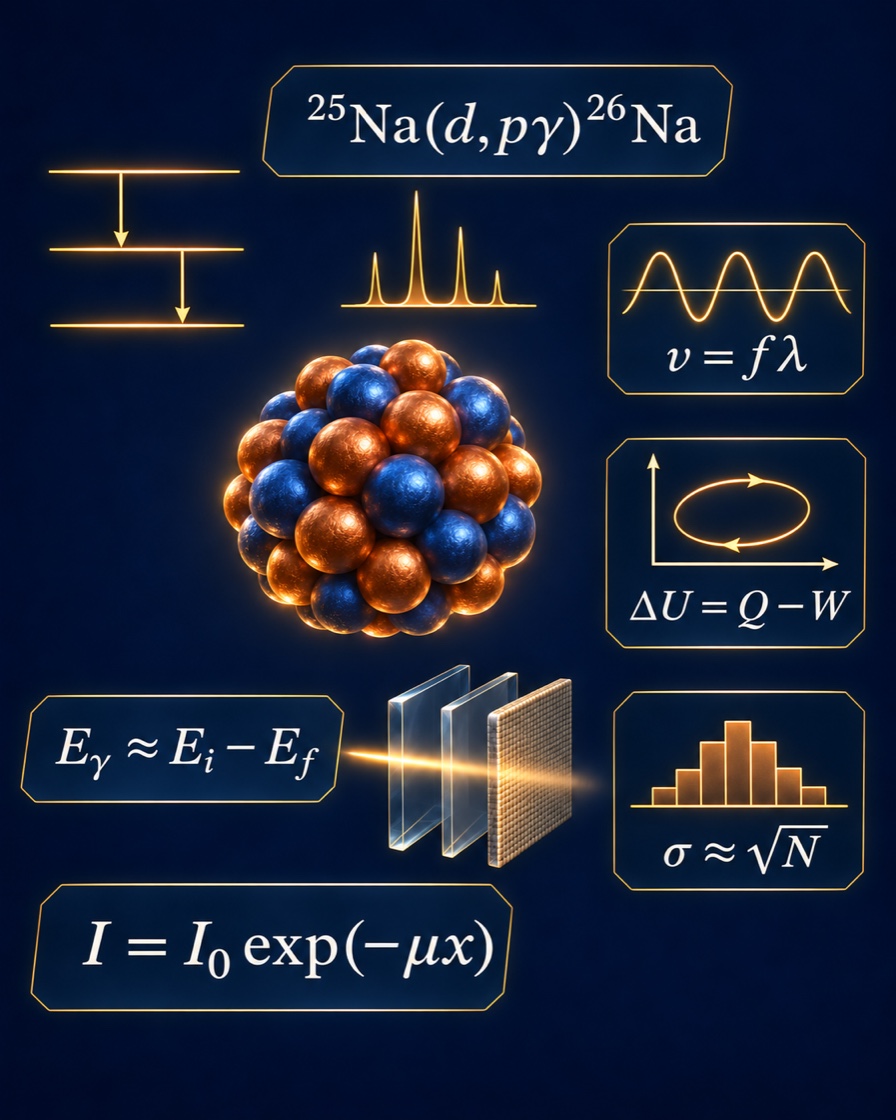
From nuclear structure experiments to radiation measurements and shielding materials.
I study neutron-rich nuclei using transfer reactions in inverse kinematics and particle–gamma coincidence measurements. My doctoral research focused on ²⁶Na.
Related publicationI use ROOT-based analytical and numerical methods to estimate photopeak areas and gamma-ray intensities.
Related publicationI investigate gamma-ray attenuation in coated textiles and glass using experimental measurements, XCOM calculations, and Geant4 simulations.
Related publicationHUBAP · Executive researcher
TÜBİTAK · Researcher / expert
Executive
Executive
Executive
Executive
Executive
Executive
Questions from selected publications and what the studies found.
The study paired narrow-beam measurements with XCOM and two Geant4 absorber models. The homogeneous model tracked XCOM closely. Explicit textile architecture made a smaller difference under the conditions investigated.
Read the article ↗ · Radiation Physics and Chemistry
The XCOM comparison found Compton scattering dominant over a broad range for the low-Z materials studied. For high-Z materials, photoelectric absorption dominated at low energies and pair production became more important at higher energies.
Read the article ↗ · Harran University Journal of Engineering · 2026
The measured excitation energies and inferred spectroscopic factors broadly agreed with shell-model calculations that used a reduced N = 20 gap. Compared with aluminum-28, sodium-26 showed a larger contribution from the neutron 1p₃/₂ configuration in its low-lying negative-parity states.
Read the article · Physics Letters B · 2016
In the sodium-26 transfer experiment, SHARC proton measurements provided excitation-energy estimates, while the higher-resolution TIGRESS gamma-ray measurements helped distinguish overlapping features. Selecting narrow intervals of excitation energy made it possible to examine which gamma-ray peaks appeared in each interval.
Read the article · European Journal of Science and Technology · 2021
Yes, in the cobalt-60 spectrum measured with NaI(Tl). In the ROOT comparison, a quadratic background fit estimated fewer background counts under the peaks and therefore gave larger net areas than the other methods. This result applies to the spectra and fits tested in the paper.
Read the article · European Journal of Science and Technology · 2022
For the isolated 661.7 keV peak in the measured NaI(Tl) spectrum, adding channels reduced the relative statistical uncertainty, with little extra gain beyond about three or four. Nearby peaks or a differently shaped background can change the choice of window.
Read the article · European Journal of Science and Technology · 2022
In the MCNP6.2 comparison of the tested boron aluminosilicate glass compositions, the formulation with the lowest value of the composition parameter X gave the greatest neutron protection. The study reported a similar trend for gamma rays. These rankings apply to the formulations and simulation conditions examined.
Read the article · Radiation Physics and Chemistry · 2024
The study compared stopping powers and ranges for several particle types and materials. Its calculations relate lower stopping power over the particle’s energy-loss path to a longer range within the same medium. The study also highlights the Bragg peak for protons and alpha particles, where energy deposition rises near the end of their paths.
Read the article · The European Physical Journal Plus · 2025
Journal articles, conference papers, and the book contribution listed in the CV.
No publications match your search.
Radiation Physics and Chemistry
Harran University Journal of Engineering
Radiation Effects and Defects in Solids
The European Physical Journal Plus
Radiation Physics and Chemistry
AIP conference proceedings 2872
European Journal of Science and Technology
European Journal of Science and Technology
European Journal of Science and Technology
European Journal of Science and Technology
Procedia Computer Science
AIP conference proceedings
AIP conference proceedings
ISBN: 978-605-7875-20-4
Physics Letters B
Physical Review C
Acta Physica Polonica B
JPS Conference Proceedings
Journal of Physics: Conference Series
I teach physics by connecting theory, computational modelling, and experimental data.
I teach physics as a practice of inquiry. Students use theory to make predictions, build models, and compare what those models predict with what they measure. In my courses, that can mean applying statistics to radiation measurements or using a computational model to explore how waves behave.
I introduce quantitative analysis with accessible tools such as Excel and develop it further with C++, ROOT, and Geant4. In open-ended projects drawn from my research, students can simulate photon attenuation in shielding materials or analyse gamma-ray spectra. I ask them to explain their assumptions, evaluate uncertainty, and document their work so someone else can reproduce it.
I introduce AI as a tool for troubleshooting code and refining algorithms. I ask students to check computational results, including AI-assisted work, against physical expectations and experimental evidence. My goal is for students to design and carry out investigations independently and communicate what their results support.
Kadir Dağlı (2022). Analytical and numerical analysis of photopeak intensity in gamma-ray spectroscopy using different algorithms.
2015–2024
Nuclear Physics I–II · Radiation Physics · Statistical Physics · Thermodynamics · Waves and Oscillations · Programming Languages I–II · Computer Applications in Physics I–II · Physics I–II and laboratories · Calculus I–II · Introduction to Modern Physics · Information Technologies · Graduation Project · Seminar
Nuclear Physics I–II · Nuclear Radiation Measurement Methods I–II · Spectroscopic Methods and Applications · Radiation and Matter Interactions and Simulations · Data Analysis I–II · Specialization courses and thesis advising
Department of Physics, Nuclear Physics
Harran University
Department of Physics, Nuclear Physics
A Particle–γ Coincidence Study of ²⁶Na Using the Transfer Reaction ²⁵Na(d,pγ)²⁶Na
Supervisor · Prof. Wilton N. Catford
During my PhD, I participated in nuclear physics experiments at TRIUMF in Canada, GANIL in France, and GSI in Germany.
Doctoral scholarship from the Ministry of National Education of Türkiye, 2009–2015.
Explore four paths from introductory physics to experimental nuclear physics. Each path includes a short explanation to get you started.
Start here if you are new to university physics.
Wave speed equals frequency times wavelength, v = fλ. If the wave travels at 12 m/s and repeats three times per second, its wavelength is 4 m. At the same speed, doubling the frequency halves the wavelength.
Explore what holds nuclei together and how they change.
A half-life is the time over which the expected number of undecayed nuclei drops by half. If a sample starts with 800 nuclei and no new nuclei are added, about 200 are expected to remain after two half-lives. The decay time of an individual nucleus is random.
Follow radiation from its interaction with matter to a measurable signal.
For independent events at a steady rate, counts in equal time intervals follow a Poisson distribution. If an interval yields about 100 counts, the estimated counting standard deviation is about 10 counts. With about 10,000 counts, the relative counting uncertainty falls from about 10% to about 1%.
Learn how to interpret a gamma-ray spectrum and quantify its peaks.
A full-energy peak is formed by events in which a gamma photon deposits all its energy in the detector. Its position, after energy calibration, estimates the photon energy. Its area above the background estimates the number of full-energy events recorded.
Planned project
I plan to create a resource for students and teachers worldwide that explains physics concepts through browser-based simulations.